
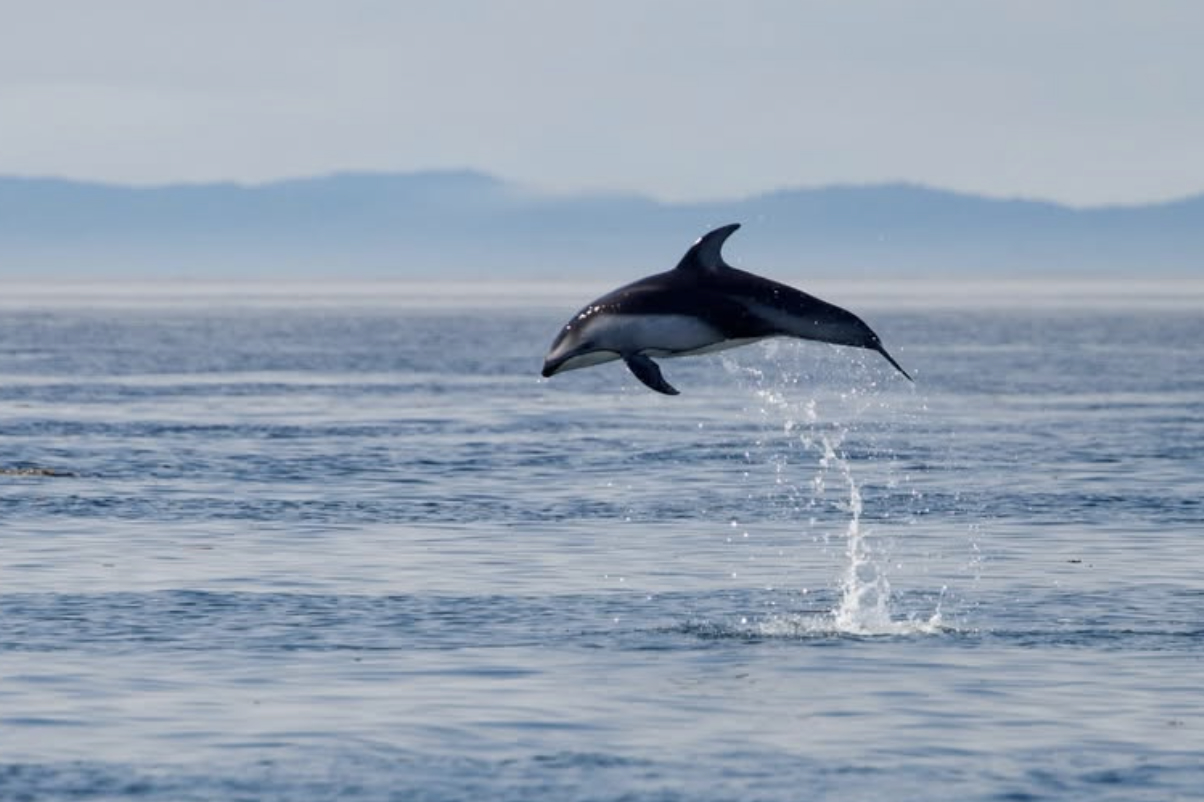
In August, with support from a few generous donors, our team spent two weeks in British Columbia’s Broughton Archipelago, returning to the longest-running study of Pacific white-sided dolphins. Our earlier breath-sampling research, published in BioScience, found these dolphins carry pathogens capable of causing disease in dolphins, orcas, and humans. Some of those bacteria are resistant to multiple antibiotics, including several that were used extensively in salmon farming. Since then, a First Nations–led initiative has decommissioned most of the open-net Atlantic salmon farms in the study area. This season was our first chance to resample the dolphins and see whether anything has changed. It’s a rare natural experiment in how antimicrobial resistance moves through the ocean. We’ll keep you posted as results emerge.
Dr. Erin Ashe, Laura Bogaard, Kimberly Nielsen, Dr. Rob Williams, and Clara Williams, collected breath samples, photo-ID images, and drone footage of dolphin body condition, the number of calves, and behavior. One of the more challenging aspects of fieldwork this year was finding the dolphins without the Northern resident killer whales. Were the dolphins harassing the orcas? Erin was quoted in a New York Times article on her theory that they’re practicing swimming around dolphin-friendly orcas to learn how to escape future attacks by the Bigg’s or mammal-hunting orcas, a phenomenon called predator inspection. This brings up an entirely new line of reason for us to unravel in future field seasons.
More importantly, we were struck by how few dolphins we saw. The hottest hotspots of dolphin activity we’ve identified since 2008 were empty. Surveys Rob conducted in the 2000s estimated over 25,000 Pacific white-sided dolphins along the BC coast. When Fisheries and Oceans Canada repeated the survey in 2018, they found about 500 dolphins in the same area–an apparent decline of roughly 98%. Even extending the survey 200 nautical miles offshore, only 5,000 dolphins were estimated in Canada’s Pacific region. We believe that Pacific white-sided dolphins are an important indicator species to detect changes in prey (e.g., herring) abundance and climate change. Our long-term photo-ID study offers the best chance to tell whether the population is crashing or simply moving in response to movements in prey.
Thank you for all your support. We are so blessed and grateful that a small group of generous, engaged donors came together to fund the season and donate new cameras for the work. A successful field season normally requires a lot of lead time and planning. While we’re proud of what we accomplished on short notice, we would love to have more time to plan a bigger, better field season next year. If you were considering making a donation or Adopting a Dolphin to support our Pacific white-sided dolphin research, now’s the time!
We came home with more questions than we left with, and that curiosity is what drives this work. It’ll take us a while to compare our ID photos against the more than 1,000 individuals in our catalog, but every season reveals new insights into this fascinating species.
We came home with more questions than we left with, and that curiosity is what drives this work.
— Dr. Erin Ashe