Oceans Initiative is proud to share that our Executive Director and Senior Scientist Dr. Erin Ashe was featured in a recent issue of Canadian Geographic magazine. The article: “A labour of love: Using photo-identification to track Pacific white-sided dolphins” discusses Erin’s long-term research to better understand this species. In fact, Erin has been studying Pacific white-sided dolphins in Canada’s Broughton Archipelago since 2005 and has devoted much of her work to protecting this population of dolphins. We hope you’ll take a few minutes to enjoy the article.
Dolphins have the ability to draw people in to really appreciate and connect with nature — and I think that’s something we all need right now more than ever.
Do you remember being a child and someone asking you, ‘What do you want to be when you grow up?’ Some of us certainly answered, ‘a Marine Biologist!’ But how many of us followed that dream? What does it even look like to be a marine scientist? Each of the womxn on our team at Oceans Initiative has their own story for what led them to pursue a career in marine science. We’ve all faced unique challenges and discovered things about ourselves along the way. Science in general is a predominantly male field, but we’re changing that one woman scientist at a time. We’re just a few of the ever-growing faces of ‘Womxn in Marine Science.’ In honor of International Womxn’s Day, here we share our stories with you to invite all budding marine scientists, particularly the underrepresented, to get curious about what it means to pursue this dream. It looks different for everyone, and we hope you feel compelled to share your stories with us in the comments section, too!
Meet the Womxn:
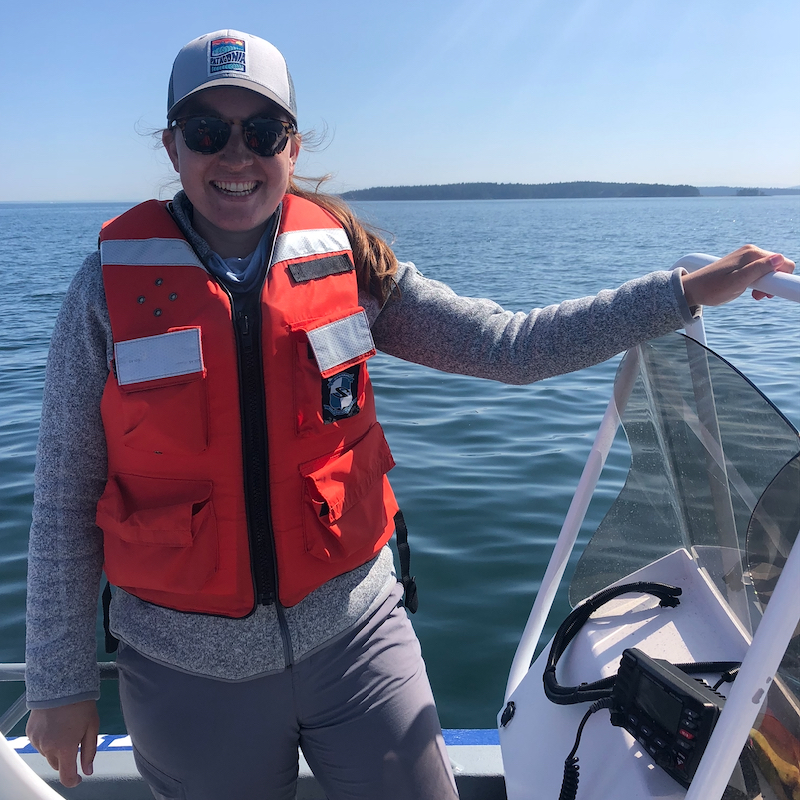
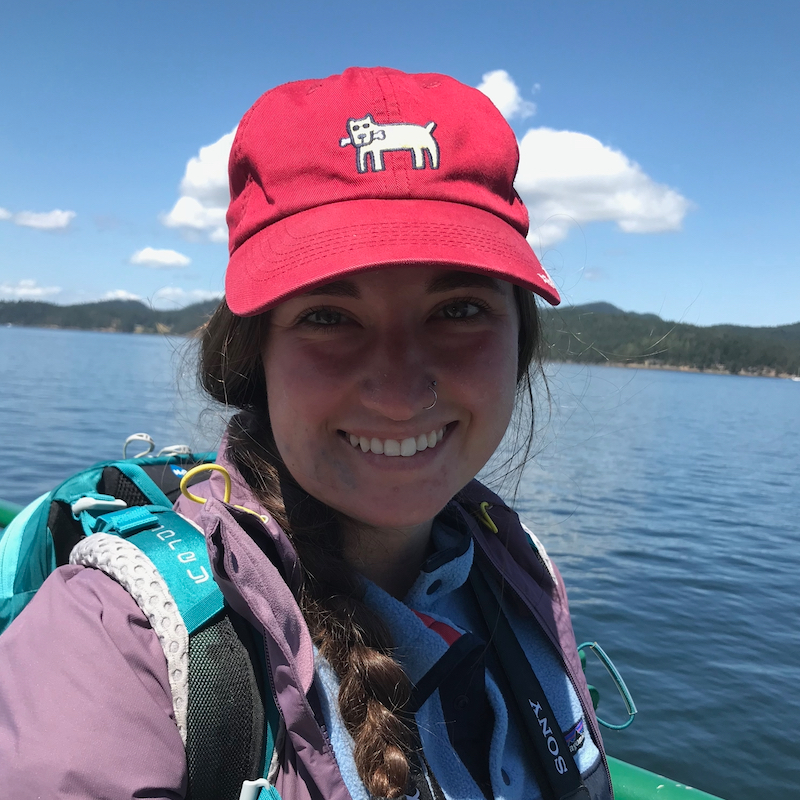
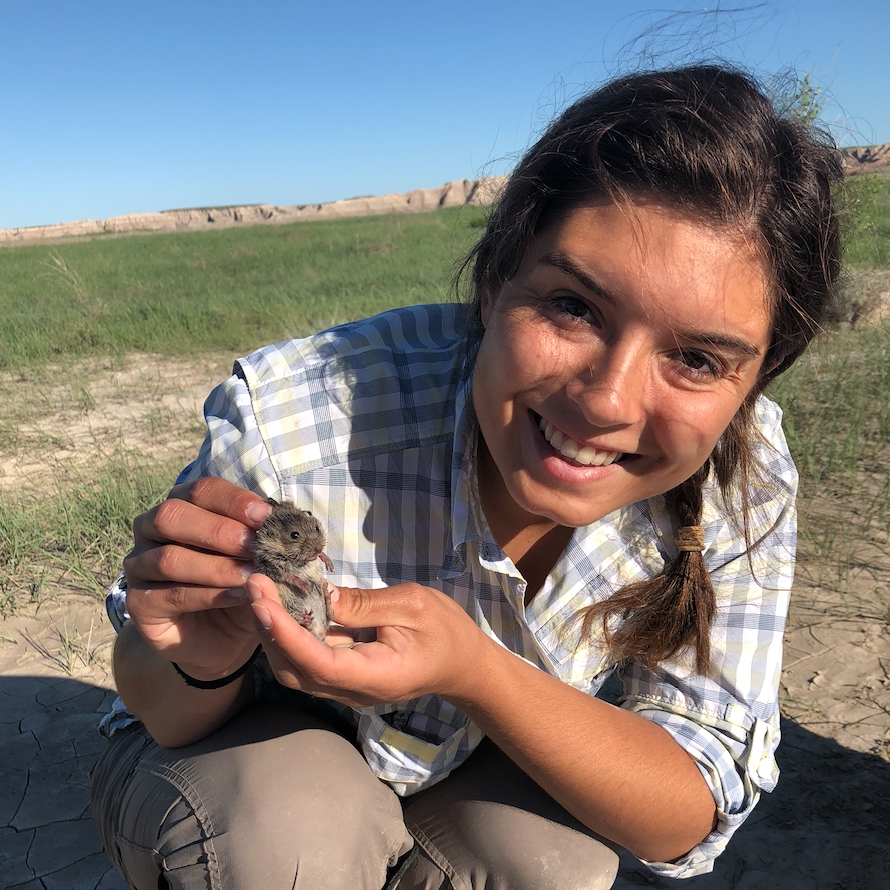
My name is Kimberly Nielsen and I’m a Research Associate at Oceans Initiative. I started as a member of the 2020 Southern Resident killer whale field team, but my role has evolved to support a variety of projects. My day-to-day involves a little bit of everything: crunching numbers, building ecological models, mapping spatial data, writing papers and reports, and collecting data in the field. Outside of work and science I find joy in hiking, paddle boarding, traveling, and reading.
My name is Marena Salerno Collins, and I am a Research Associate with Oceans Initiative. I have been working for the organization for almost 4 years and have held various roles over that time. I am grateful for the organization and the inspiring womxn I get to work beside every day. Besides my work in marine science, I am a musician, artist, sailor, and avid outdoor enthusiast.
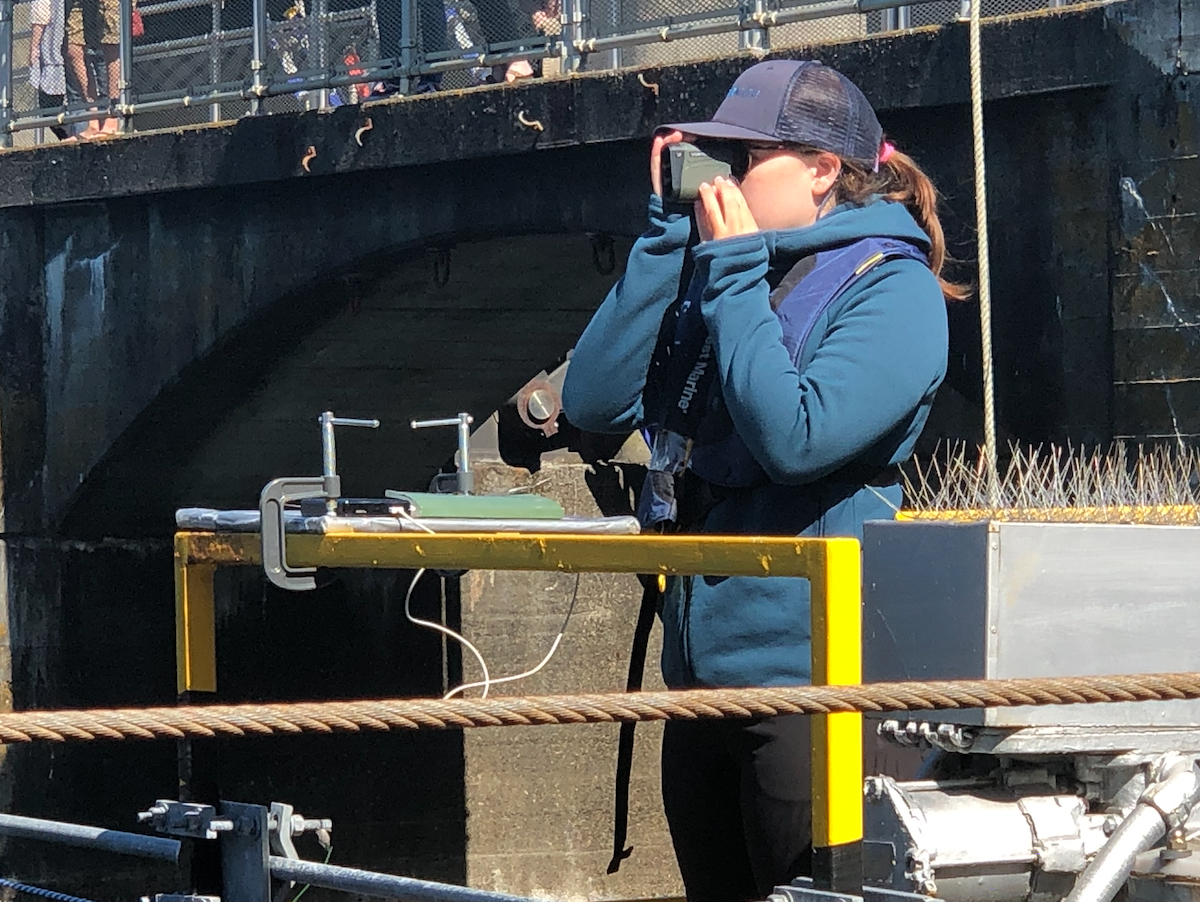
My name is Katie Wold and I am a Biological Research Technician for Oceans Initiative. I have worked primarily on the TAST (Targeted Acoustic Startle Technology) project, which involved counting seals and recording their distance from the device to evaluate the efficacy of our acoustic deterrent device. I’m also part of the team theodolite tracking Southern Resident killer whales around San Juan Island. I am so thankful to be part of team that works together on a variety of projects that make a difference to marine life locally and around the world.
My name is Stephanie Reiss and I am a marine biologist, field researcher, and natural world enthusiast. I am a Biological Research Assistant with Oceans Initiative. Under this role, I have participated in data collection in the field, post-processing, report writing, and more. I have gained a variety of skills during my time with Oceans Initiative including theodolite tracking of cetaceans, Targeted Acoustic Startle Technology (TAST), and hydrophone deployment. Outside of work, I enjoy writing, reading, cooking, and all kinds of outdoor activities.
My name is Andrea Mendez-Bye. I am a scientist, a friend, a daughter, and a woman. I am a highly passionate and driven person with a huge goal of saving as many animals as I possibly can. I get overly excited and feel so much joy from the work I do. My role with Oceans Initiative is currently working on analyses of data on Pacific white-sided dolphins as well as the Targeted Acoustic Startle Technology (TAST).
How and why did you get involved in Marine Science and Oceans Initiative?
Kimberly: I’ve always felt at home on or under the water. Growing up in southern California, I spent a lot of time at the beach tide pooling, body surfing, and freediving. That passion for the ocean naturally evolved into curiosity so I pursued a degree in Marine Science. After spending a few years doing remote fieldwork studying sea turtles and cetaceans, I recognized that I was lacking some quantitative skills and decided to complete a graduate degree focused on statistics and spatial ecology. This work fit perfectly with the mission of Oceans Initiative.
Katie:Growing up around the Puget Sound, I’ve always loved exploring and investigating the marine world. Some of my earliest memories are poking around in tide pools, trying (and failing) to catch small fishes, finding hermit crabs, and watching seals pop their heads out of the waves. As I grew older, my curiosity for marine life grew with me. In high school I began volunteering at the Seattle Aquarium, where I learned so much about the organisms I’d been seeing my whole life that I was inspired to further my knowledge by studying Aquatic and Fishery Sciences at the University of Washington. After gaining experience from a variety of field research projects, I began working for Oceans Initiative during the summer of 2021.
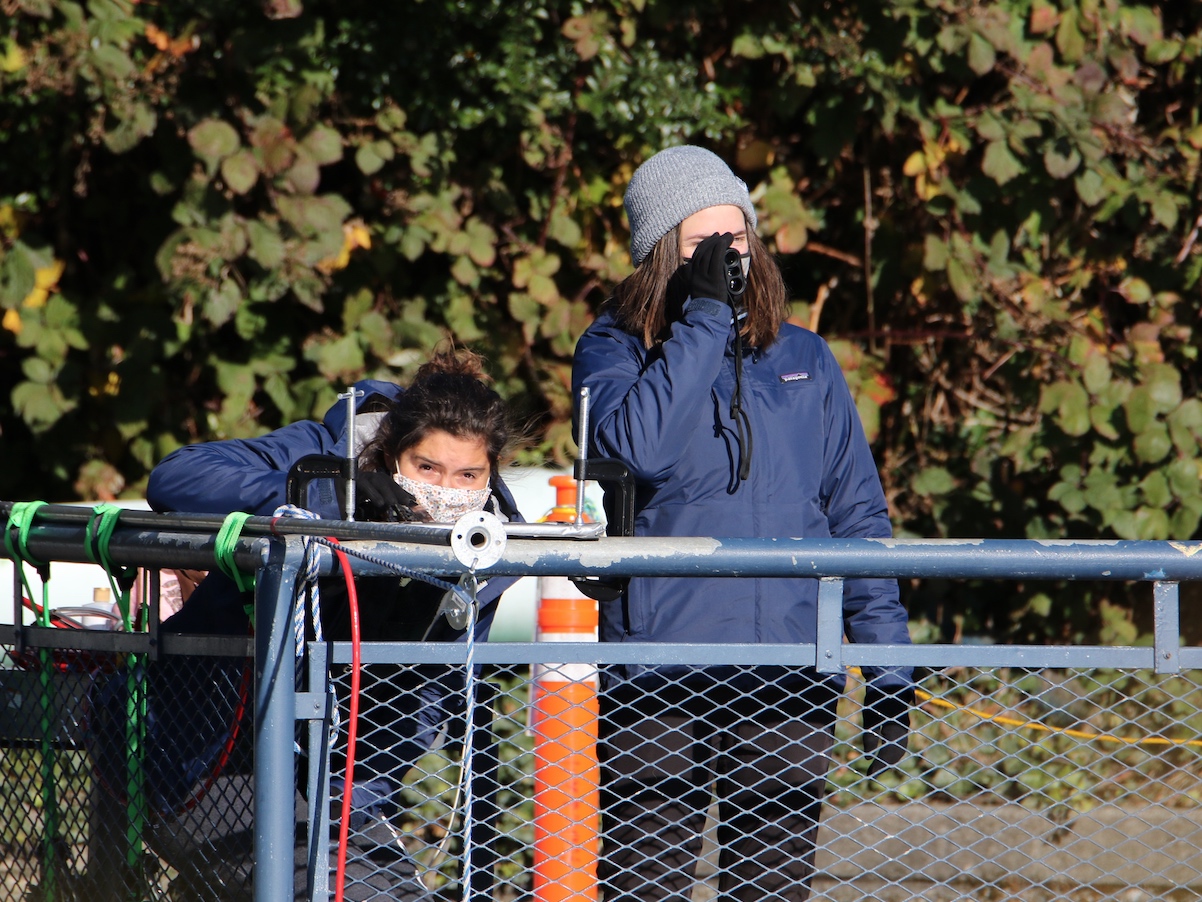
Katie Wold collecting data on harbor seal responses to Targeted Acoustic Startle Technology at Ballard Locks, Seattle.
When do you feel most empowered in your work and what is one project you are working on that inspires you? Why?
Marena: I feel most empowered and inspired when I see evidence of actual action towards conservation efforts because of the work we do. While working with Oceans Initiative, I have seen multiple projects go from conception to publication. To see how an idea can become a groundbreaking piece of science is astounding. I feel empowered in these moments because I feel and see our power as womxn in marine science and am briefly able to quantify our impact.
Stephanie: I feel most empowered in my work when I am working with others who inspire me or encourage me to be at my best. The Southern resident killer whale project inspires me because it is a project with a lot of weight behind it—working with an endangered population—and sometimes, it can feel pretty heavy. However, myself and the rest of the team share a passion and desire for helping and protecting them so much so that even when we have really long days or a challenge pops up, we all rise to the occasion.
Andrea: I feel most empowered in work when I see amazing things happen in front of me. Two major examples of this are in the field and in the office. When I am in the field and I see something incredible, such as a super pod of Southern resident killer whales in the sunset with a close knit team I feel unstoppable. Or when I am in the office working hard on an analysis and a significant trend appears, I get really excited and feel like I can do anything. A project that inspires me currently is the dolphin project, there are so many questions to be asked regarding Pacific white-sided dolphins currently. I feel fortunate to have an inquisitive brain, when I start to ask questions and figure out the answers piece by piece it is rewarding in a way that is hard to explain.
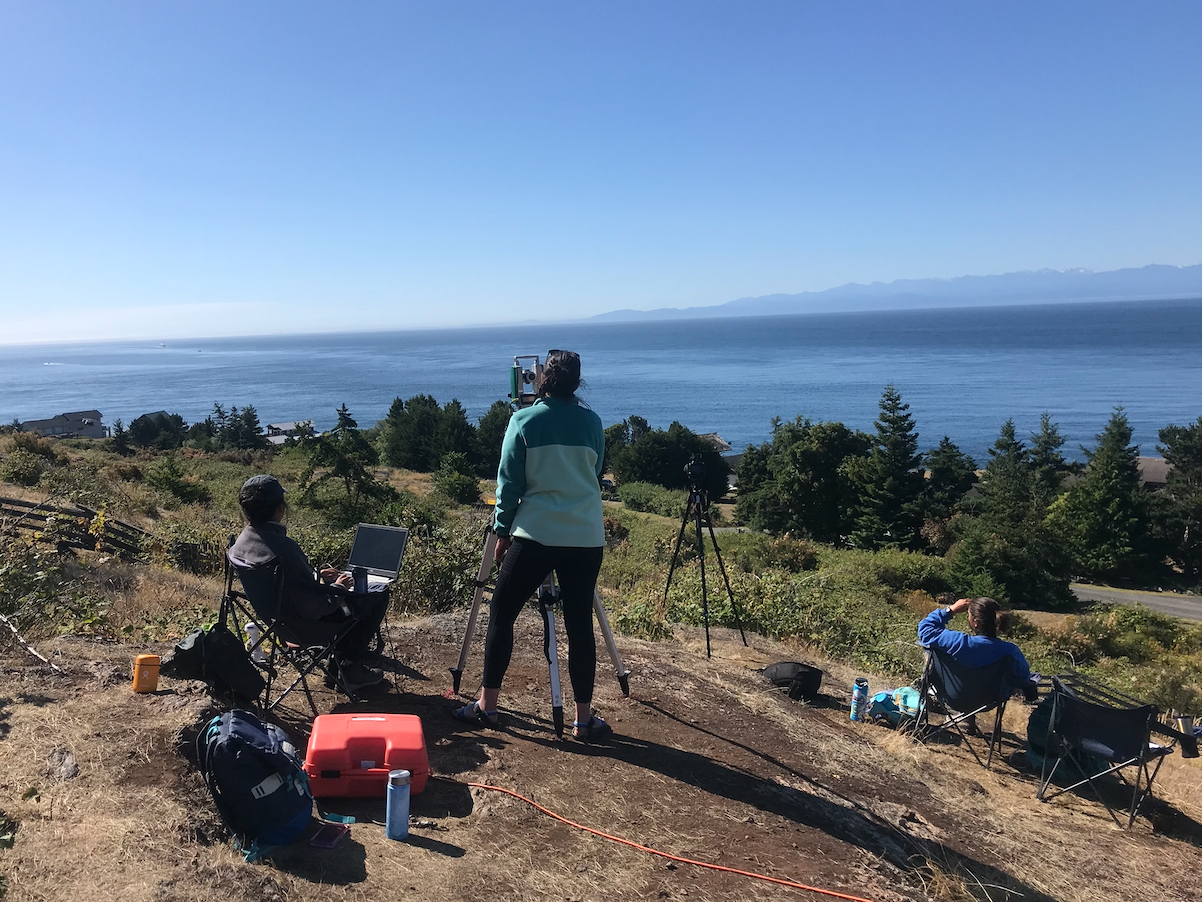
Members of the 2021 Southern resident killer whale field team theodolite-tracking from land on San Juan Island (including: Kimberly, Andrea, and Stephanie behind camera).
What are you looking forward to in your career (near or far in the future)?
Katie: I’m looking forward to continuing to study organisms and ecosystems that fascinate me. I hope to continue conducting field work and spending as much time outdoors and collecting data as I can. I’m also looking forward to furthering my education and becoming more comfortable with the statistical side of research.
Stephanie: I am looking forward to more learning opportunities in the field. I love the “learning-while-doing” approach of some fieldwork. One thing that is ever-present in fieldwork too is unpredictability. You can do your best to be prepared for any scenario but there will always be some moments that you simply could not have foreseen. I look forward to those moments too because it offers the unique opportunity to respond to challenges that you may or may not have encountered before.
Andrea and Stephanie doing fieldwork with Targeted Acoustic Startle Technology at Whatcom Creek in Bellingham.
Did you have a womxn role model that influenced your decision to pursue this career? If so, who?
Kimberly: I’ve been lucky to have so many strong, inspiring womxn in my life who taught me to believe in myself. When I started studying marine science and oceanography, however, I really struggled to find a mentor in a field dominated by men—many of whom didn’t take my research interests seriously (and voiced that to me multiple times). It took a little longer than planned, but I carved a nonlinear path into the career that I wanted. I am so grateful to all of the womxn I’ve had the opportunity to work with and learn from along the way, including the ladies at Oceans Initiative who continue to inspire me with their dedication and innovation.
Marena:Erin Ashe has been an incredible role model and inspiration for me. Because I started my marine science career with Oceans Initiative, I just thought it was normal to do everything she does, as she was the only example I had. However, I quickly realized, and continue to believe, that she is a marine science superhero. She has been illustrating for decades what is possible for womxn in this field while simultaneously empowering countless people along the way.
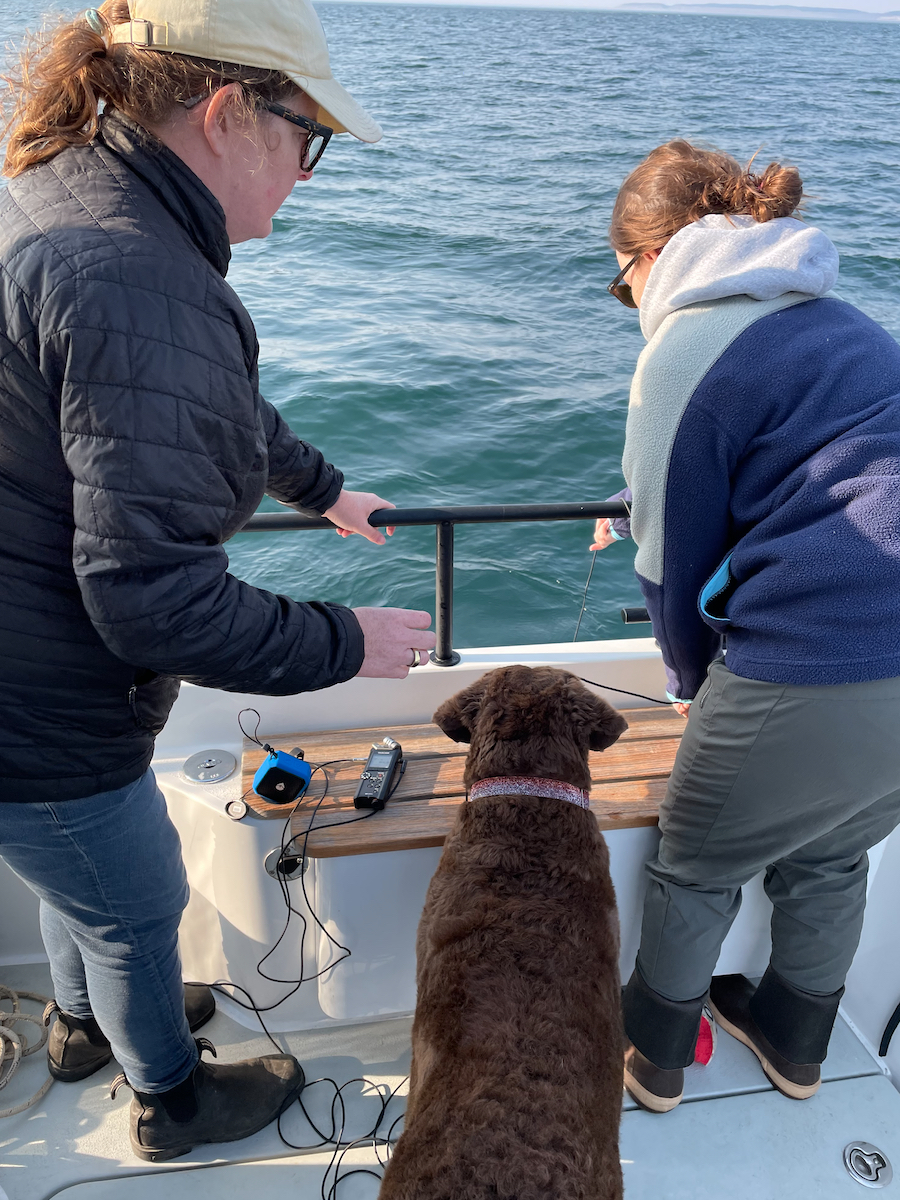
Dr. Erin Ashe and Katie deploying a hydrophone off the Oceans Initiative research boat ‘Wishart’ (featuring Molly Brown dog).
What challenges or differences do you believe still exist in the field of science, if any?
Andrea: The major challenges that still exist are the opportunities to find a good job. It takes many scientists, both womxn and men, a long time to enter this field because of the lack of resources. Additionally, a big hurdle to climb is the very competitive environment that can potentially stop people from joining or sharing science for the benefits of the animals.
Katie: There is still a huge reliance on unpaid internships and volunteering to gain experience that is necessary to secure future jobs or graduate positions. This is an obstacle for a lot of early career scientists, and often results in a lack of diversity of backgrounds, experiences, and points of view that I believe is a massive loss to our field.
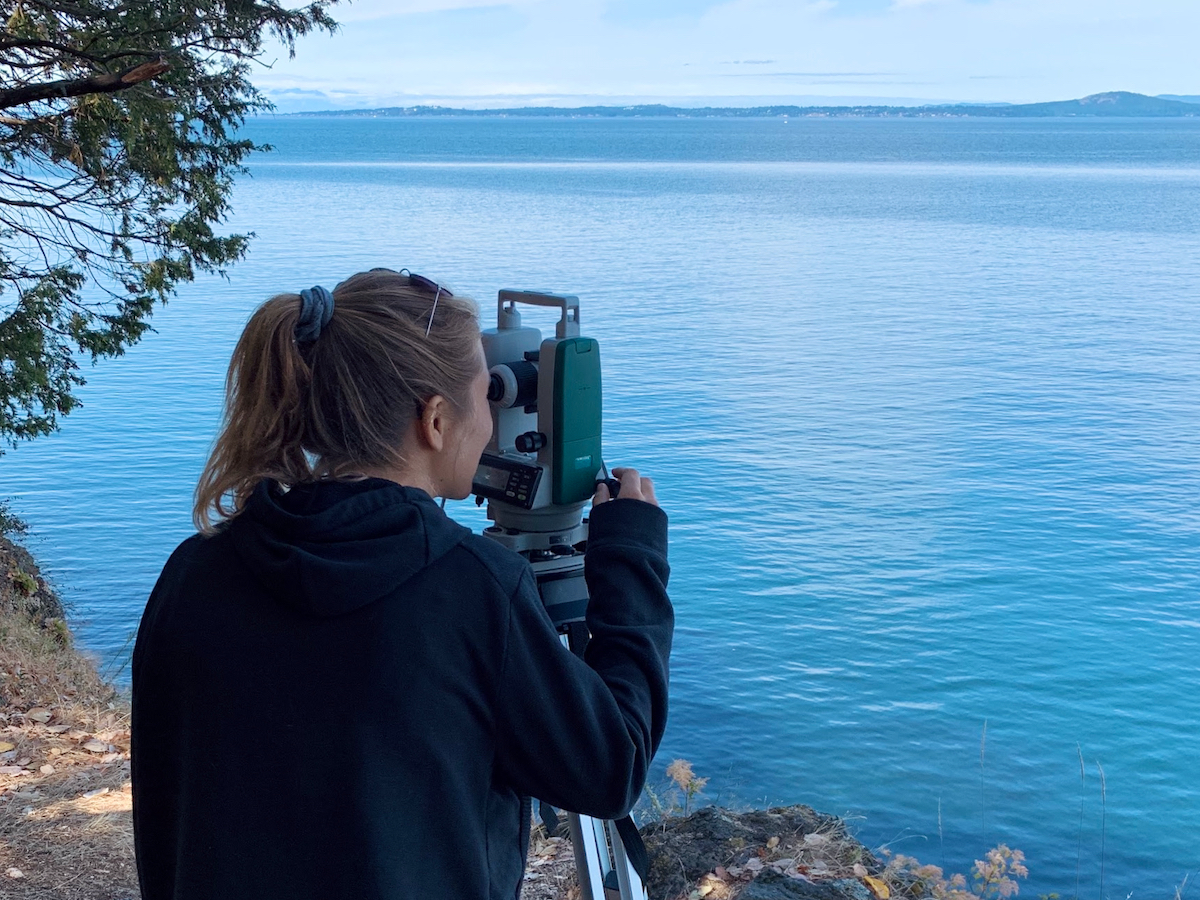
Marena operating the theodolite at San Juan County Park.
What is some advice you would share with a womxn who is interested in going into marine science?
Andrea:Don’t give up! When things are hard and you feel like quitting, hold on to a special moment that can’t be replaced. That way you will always have motivation. I call them my National Geographic moments, the moments with wild individuals that will always glow in my mind like highlighting a favorite quote in a book.
Marena:The advice I would give a womxn who is interested in going into marine science would be: You can do anything you set your mind to. I know it sounds cheesy, but it is also some of the best advice I have ever gotten. Just take one step at a time, see where you want to be and work towards it, even if only in baby steps. Don’t get discouraged by not getting there immediately or taking steps that don’t have a positive linear trend. Additionally, don’t be afraid to stand up for yourself and know your worth both as an individual and a scientist. Not knowing something is not synonymous to failing, it just means there are still things to learn.
Kimberly: There are certain challenges to being a womxn in STEM, and unfortunately, on top of the imbalance created by a biased system, some of the barriers we run into are those we make for ourselves. To any womxn pursuing a career in STEM or marine science: remember that you are brilliant, you are an integral part of any team you’re on, and your perspective matters. Everyone’s path into this field looks different and our career timelines are often self-imposed. It is never too late to go after your goals.
Stephanie: Some advice that I would share with womxn interested in marine science is to broaden your perspective of what fits within the bounds of “marine science.” There are all kinds of opportunities that involve marine science that are not necessarily the status-quo. Pick up different kinds of skills and experience where you can (such as fieldwork, statistical analysis, scientific writing etc.) and don’t feel discouraged if you try something and discover that you simply don’t like it. You can pursue a career in marine science without being a field researcher, statistician, or grant writer. There are a multitude of possibilities but the more you introduce yourself to a variety of skills, the more prepared you will be to tackle any obstacles that come your way.
Katie: I would advise any womxn looking to get into marine science to get as much experience as you can while you’re an undergraduate student! Talk to your professors, see if they or any of their graduate students need help in the lab or with their field work. Even if your research is in a slightly different field, any experience you gain can be relevant for a future project in marine science, and building a good foundation of skills and working on a team is very helpful when pursuing marine science. Try not to let yourself be intimidated by the field of marine science—when I was younger I never thought I would pursue marine science because I didn’t think I fit the image in my head of a “scientist”. There are so many ways to be involved in marine science, from research to policy to scientific writing to outreach and education, so don’t stop yourself from trying before you even know what’s possible.
Kimberly and Stephanie after a successful hydrophone deployment off the westside of San Juan Island.
Peer-reviewed study calls for more research to understand threats to this unique habitat
WASHINGTON (July 7, 2022)— New research published today in the peer-reviewed journal Science examines the potential for underwater noise pollution from seabed mining operations, which could affect the understudied species that live in the deep sea—the largest habitat on Earth.
The study by scientists from Oceans Initiative, the National Institute of Advanced Industrial Science and Technology (AIST) in Japan, Curtin University in Australia, and the University of Hawaii—and funded by The Pew Charitable Trusts—found that noise from one mine alone could travel approximately 500 kilometres (roughly 311 miles) in gentle weather conditions, with cumulative impacts likely in places where multiple mines operate.
The deep sea is home to organisms found nowhere else on Earth—many of whom, given the absence of sunlight, likely use sound to navigate, communicate, find mating partners, locate food, and detect predators and other dangers.
Seventeen contractors are exploring the possibility of mining in the Clarion-Clipperton Zone (CCZ), an area spanning 4.5 million square kilometres (1.7 million square miles) between Hawaii and Mexico and a prime focus of deep-sea mining interest. If each of the contractors were to launch just one mine, an estimated 5.5 million square kilometres (2.1 million square miles)—an area larger than the European Union—would have elevated noise levels. Not only could this level of mining activity have untold impacts on noise-sensitive species, it could also undermine attempts to preserve areas with no mining impact—known as “preservation reference areas”—to use for scientific comparisons.
“What surprised me most was how easy it would be for noise from just one or two mines to impact nearby areas that have been set aside as experimental controls,” said Rob Williams, co-founder of Oceans Initiative. “With so many unknowns, we need a careful comparison of these preservation reference areas to sites where mining is taking place in order to understand mining’s impacts. But noise will cross the boundaries between preservation zones and mining sites.”
Added Craig R. Smith, a professor emeritus at the University of Hawaii, “Our modeling suggests that mining noise could impact areas far beyond the actual mining sites, including preservation reference zones, which are required under draft mining regulations to be unaffected by mining.” This finding, he said, “could require rethinking of environmental regulations, including the number of mining operations allowed within the CCZ.”
Although mining companies are already testing smaller-scale prototypes of deep-sea mining systems, they have yet to share their data on underwater noise pollution. So the Science article had to use noise levels from better-studied industrial activities, such as oil and gas industry ships and coastal dredges, as placeholders. True noise levels from deep-sea mining may vary once the data is available—but, says Andrew Friedman, project director of Pew’s seabed mining project, they’re more likely to be higher than the proxy data than lower because actual seabed mining equipment is much larger and more powerful than the proxies. “These are probably conservative estimates.”
Christine Erbe, a professor at Curtin University, said, “Estimating the noise of future equipment and installations is a challenge, but we don’t have to wait until the first mines are operational to discover the noise they make. By identifying the level of noise in the engineering design phase, we can better prepare for how this might impact marine life.”
The island nation of Nauru invoked a United Nations rule two years ago that could force the International Seabed Authority, the intergovernmental organization that regulates all mineral activities in areas beyond national jurisdiction, to complete regulations that would enable large-scale mining by July 2023—or consider mining proposals without internationally agreed regulations in place. The move came despite concerns expressed by governments, corporations, and civil society organizations that the science and governance surrounding mining in the deep ocean remain inadequate.
The Science study joins a growing body of research that finds it unlikely that adequate data to assess the ecological risks from mining noise will be collected before the July 2023 deadline. For this reason, a growing number of countries, experts, corporations, and environmental organizations are calling for a halt to any seabed mining, unless and until science and management can be put in place that ensure that mining will not cause harm to the marine environment. Pew’s Friedman said that the study “highlights how much remains unknown about mining’s potential impacts, not just on the deep ocean, but throughout the water column.”
“The deep sea houses potentially millions of species that have yet to be identified, and processes there allow life on Earth to exist,” said Travis Washburn, a deep-sea ecologist at AIST. “While much work is still needed to determine the extent and magnitude of environmental impacts from deep-sea mining, with careful study and management we have a unique opportunity to understand and mitigate human impacts to the environment before they occur.”
Rob Williams*, Christine Erbe*, Alec Duncan, Kimberly Nielsen, Travis Washburn, Craig Smith. 2022. Noise from deep-sea mining may span vast ocean areas. Science 377.6602: 157-158. *—These authors contributed equally to this work.
On Thursday, April 16, we have a very special guest, Sophia Trinh, joining our Virtual Marine Biology Camp. Sophia has very generously offered to lead a free ocean-themed painting class for kids of all ages. In this hour-long session, we’ll be learning to paint the iconic killer whale!
Sophia Trinh is an American-Vietnamese watercolor artist from Seattle, Washington. She started painting at the age of four and soon developed a love for watercolors. Today, Sophia’s work is a synthesis of creativity, and imagination, science, and geometry. She is inspired to use art as a tool to engage others, and communicate ideas. Sophia’s hope in sharing her art with the world is that others will be encouraged to find space in their lives for art and creativity. You might enjoy following Sophia on Instagram.
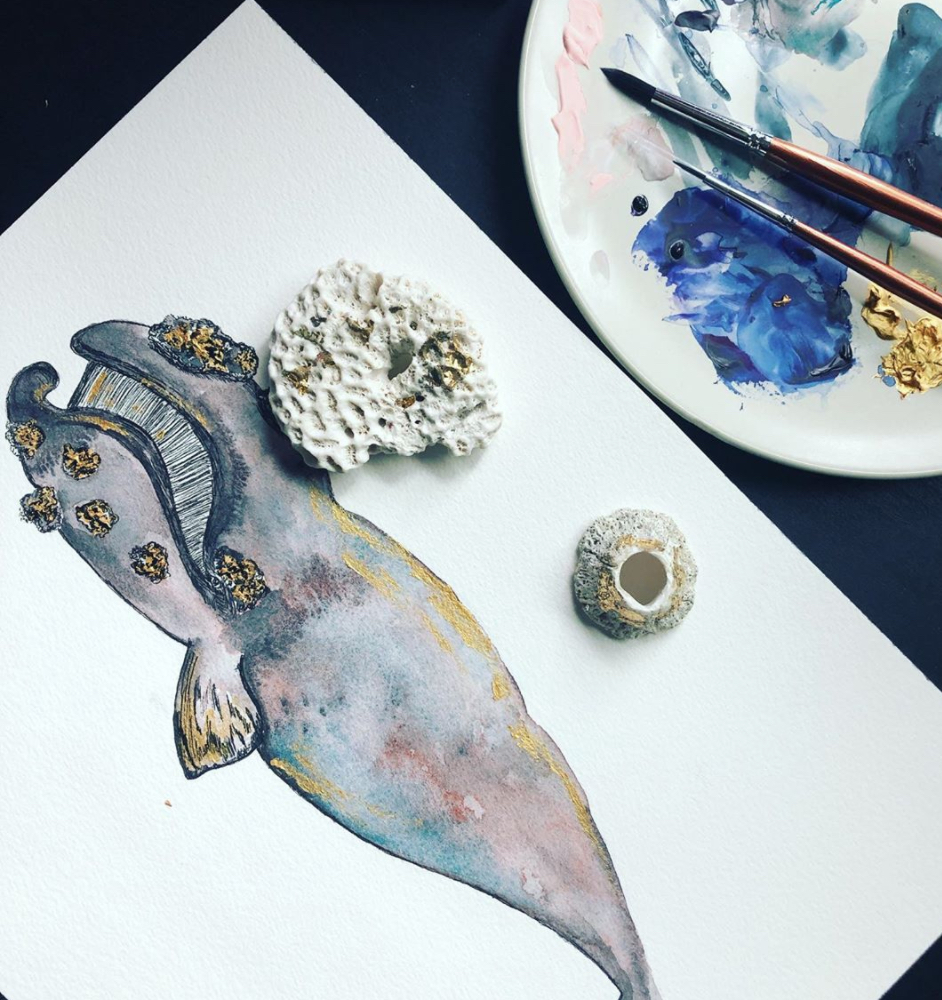
In addition, Sophia has kindly agreed to donate an original painting of an endangered North Atlantic right whale (shown above) to Oceans Initiative. Oceans Initiative works with colleagues at New England Aquarium and NOAA to try to help protect these endangered whales by reducing impacts of ocean noise, ship strikes, and entanglement in fishing gear. We invite you to make a donation to support our conservation mission. Sophia will select the winner of the painting.
Visit our Get Involved page to make a tax-deductible donation in the USA.
Our Canadian friends and neighbours may make a tax-deductible donation here.
Whether you donate or not, please know the art class is free, like all of the sessions we’ve done so far. We hope to see you online Thursday, April 16, at 11 am (Seattle time) for this very special ocean-themed painting class with Sophia! Watch for updates, as we identify the best free platform to use, so you can watch Sophia live on Thurs. Please have ready your watercolor paints, paintbrushes, paper, and a rag or towel. We can’t wait to see what you create!
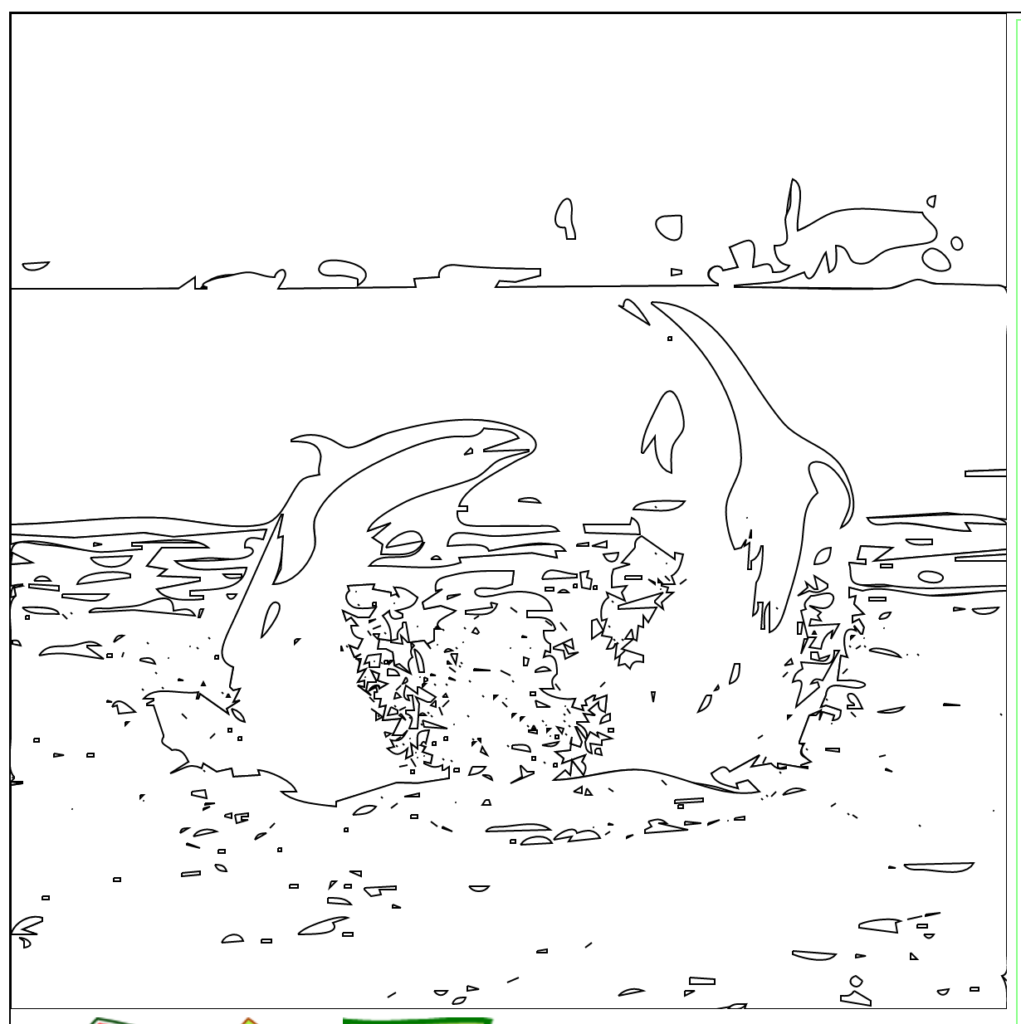
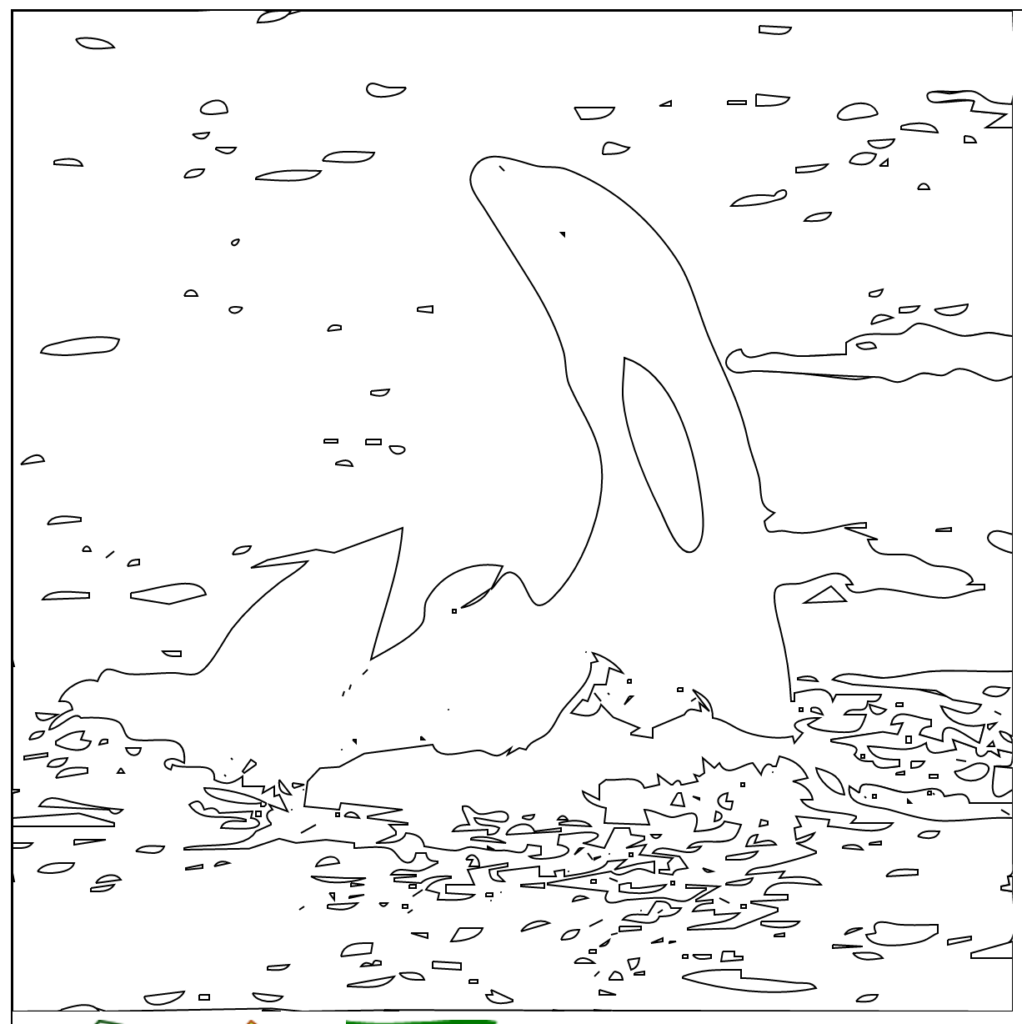
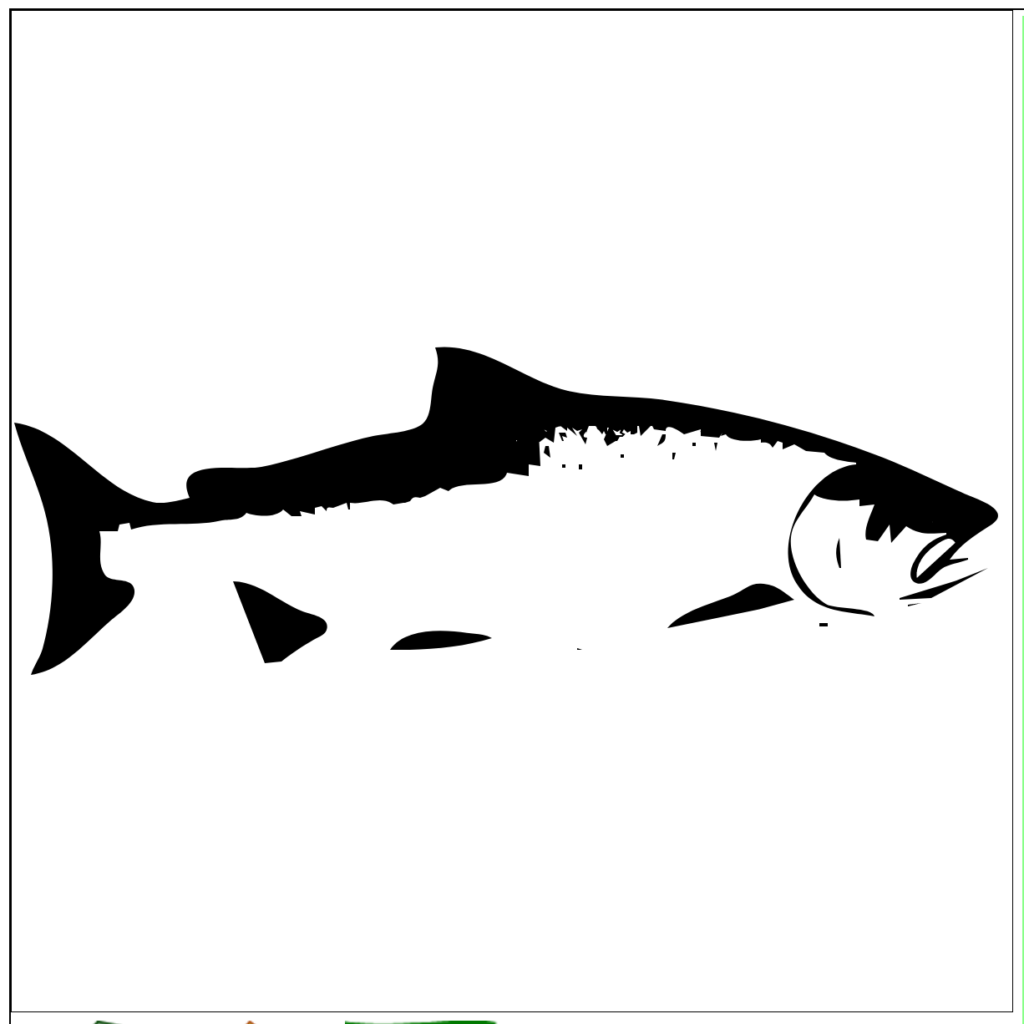
A few of you have asked for projects for your kids to do between our episodes. We’d love to see your kids coloring these images of the outline of a Chinook salmon, a spyhopping orca (check out our social media logos for inspiration), and a pair of leaping Pacific white-sided dolphins. Email colored images, or your own drawings, to team AT oceansinitiative DOT org. Need some inspiration for your drawings? Check out our photos by following us on Instagram.
We are thinking about summarizing these interviews into an e-book of the most commonly asked questions. We’d make it free to download, with a suggested donation to support our conservation mission. If you submit your images by email, we may use your child’s drawing (with first name and age) in our book.